You Don’t Need to Heal Yourself 24/7: How to Recognize Spiritual Burnout
Sometimes a spiritual practice that was meant to support you starts to feel like one more thing you have to keep up with.
Meditation. Journaling. Prayer. Breathwork. Energy work. Shadow work.
Even reading that list can feel exhausting when you are already carrying too much.
If your healing journey has started to feel like pressure, it does not mean you are doing spirituality wrong.
It may simply mean you need a different pace.
Spiritual growth is not supposed to disconnect you from your body, your life, or your peace.
It is supposed to help you come back to yourself.
Prefer to Watch?
In this Spiritual Spotlight Quick Tip, I talk about what happens when healing becomes another source of pressure—and why doing less may sometimes be exactly what your system needs.
Key Takeaways
Spiritual burnout can begin when supportive practices start feeling like obligations.
Constantly consuming spiritual content can create more confusion when there is no time for integration.
Rest and nervous-system support are important parts of a sustainable healing practice.
You do not have to earn rest by completing more inner work.
Simpler spiritual practices can sometimes reconnect you with yourself more effectively than adding another modality.
Spiritual growth does not have to feel productive in order to be meaningful.
What Is Spiritual Burnout?
Spiritual burnout can happen when the practices that once helped you feel connected begin to feel like another list of things you should be doing.
You may still meditate.
Journal.
Read spiritual books.
Listen to podcasts.
Take courses.
Work with healing modalities.
But somewhere along the way, what once felt nourishing begins to feel like pressure.
Instead of helping you feel more connected, your spiritual practice begins making you feel behind.
Not healed enough.
Not disciplined enough.
Not intuitive enough.
Not spiritual enough.
That is worth paying attention to.
Healing does not have to become another way to criticize yourself.
Here are three signs it may be time to slow down.
1. Your Spiritual Practice Feels Like a Performance
One of the clearest signs of spiritual burnout is when your practices begin feeling like something you have to perform perfectly.
Maybe you feel guilty when you miss a meditation.
You skip journaling for one morning and somehow feel like you have failed spiritually before breakfast.
You break a meditation streak and suddenly the little tracker on your phone feels less like encouragement and more like it is personally disappointed in you.
That is your cue to remember:
You are allowed to miss a day.
You do not need to meditate every night, journal every morning, pull a card, cleanse your energy, or complete every spiritual practice perfectly in order to remain connected.
A practice is supposed to support you.
You are not supposed to spend your life supporting the practice.
When spirituality begins making you feel constantly behind or as though there is always another part of yourself that needs fixing, pause.
Growth does not require nonstop effort.
2. You Are Consuming More Spiritual Content but Feeling Less Connected
Another sign is constantly looking for the next answer while becoming less clear about what you actually believe.
One video leads to another.
Then another podcast.
Another book.
Another course.
Another certification.
Another crystal.
Another modality.
And before you know it, your spiritual journey has developed a shopping cart.
There is nothing wrong with learning.
I love learning.
There is nothing wrong with exploring new practices or discovering a modality that resonates with you.
The problem begins when consumption replaces integration.
Sometimes we collect so much information that we stop listening to ourselves.
Instead of asking, “What do I already know?” we immediately look for another teacher to tell us.
Instead of sitting with what we have learned, we move on to the next thing.
More information is not always the answer.
Sometimes you need less input and more space.
Before signing up for the next class or searching for the next spiritual explanation, ask:
What do I actually need right now?
The answer may not be another modality.
It may be quiet.
3. Rest Feels Like Something You Have to Earn
This one can be sneaky.
You tell yourself:
I’ll rest after I process this.
I’ll slow down after I finish this healing work.
I’ll enjoy myself once I have cleared this pattern.
I’ll feel peaceful when I become a more healed version of myself.
But that finish line keeps moving.
There will always be another layer.
Another lesson.
Another opportunity to grow.
If rest only becomes available after you are completely healed, you may be waiting a very long time.
Rest is not the prize you receive for doing enough inner work.
It is part of taking care of yourself while you are doing the work.
Pausing is not quitting.
Stillness is not laziness.
And taking a break from spiritual practices does not mean you have abandoned your path.
Sometimes your body simply needs space.

How to Ease Spiritual Burnout
If you recognize yourself in any of these patterns, the answer does not have to be complicated.
Actually, complicated may be exactly what you do not need right now.
Do Less. Seriously.
Choose one or two practices that genuinely support you.
Let the rest sit on the shelf for a while.
Maybe your spiritual practice today is three slow breaths.
A short prayer.
Putting your feet on the ground.
Taking a walk.
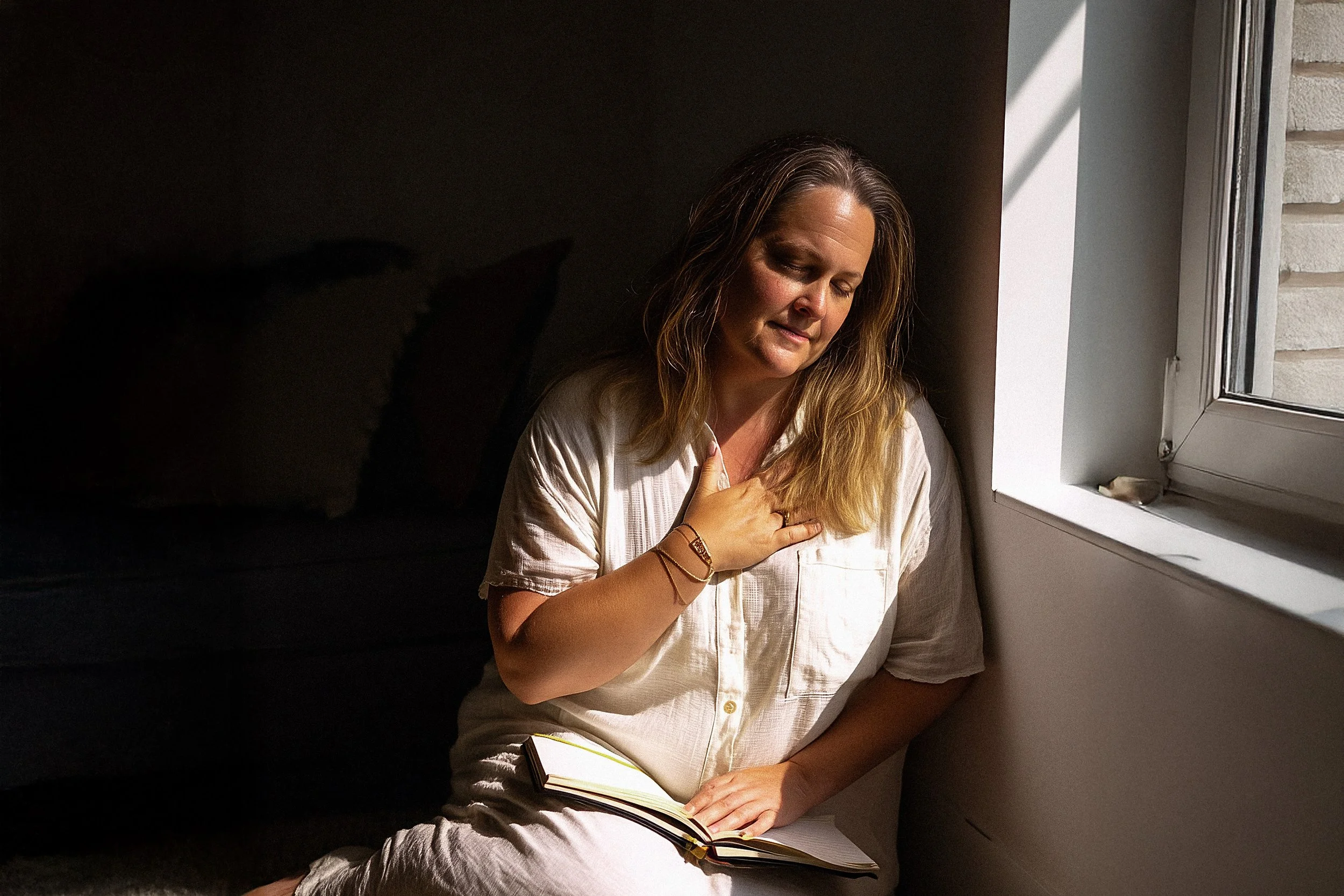
Sitting quietly with your hand over your heart.
You do not need an elaborate ritual every time you want to reconnect with yourself.
Simple still counts.
Make Room for Rest Without Explaining It
You do not need to justify why you need a break.
You are allowed to sit on the bench for a minute.
You do not need to immediately research the next healing technique, enroll in another program, or identify another thing that needs fixing.
Give yourself permission to stop striving.
There is wisdom in pausing.
Stop Measuring Growth by How Much You Do
Spiritual growth does not always look productive.
Sometimes growth looks like becoming less reactive.
More present.
More honest.
More grounded.
More willing to say no.
More capable of receiving support.
More comfortable being yourself.
You do not need a checklist to prove that transformation is happening.
Pay attention to how you are actually living.
That often tells you much more than how many practices you completed this week.
Come Back to This Moment
Sometimes the most supportive thing you can do is breathe and ask:
What do I need in this moment?
Not tomorrow.
Not six months from now.
Not after you become the fully optimized, completely healed, eternally peaceful version of yourself.
Right now.
Maybe you need quiet.
Maybe you need movement.
Maybe you need laughter.
Maybe you need sleep.
Maybe you need to go outside and remember that the spiritual world still exists even when your phone is not involved.
Guidance can arrive in very ordinary moments.
Birds outside your window.
Wind moving through the trees.
A conversation.
A sudden moment of clarity.
A quiet knowing that says:
Enough for today.
Listen to that too.
Your Spiritual Practice Should Support Your Life
There is a difference between spiritual discipline and spiritual pressure.
A meaningful practice can absolutely ask us to grow, stretch, reflect, and become more conscious.
But it should not become another system for proving our worth.
You do not need to heal around the clock.
You do not need to process every emotion immediately.
You do not need to understand every trigger before bedtime.
And you definitely do not need to become a full-time project.
You are allowed to live while you heal.

Rachel’s Takeaway
One of the things I have learned through my own spiritual journey is that there will always be another layer to explore.
There will always be another insight.
Another pattern.
Another opportunity to grow.
But if we are constantly searching for the next thing to heal, we can accidentally begin treating ourselves as though we are never quite okay as we are.
That is not the kind of spirituality I want to practice.
Healing can be deep without becoming heavy.
Spiritual growth can be meaningful without becoming another full-time job.
Sometimes the most powerful thing you can do is stop searching for what needs to be fixed and ask:
What would help me feel more like myself today?
You may not need another breakthrough.
You may simply need a breath.
A little space.
And permission to be exactly where you are.
Ready to Go Deeper?
If your healing journey has started to feel overwhelming, you are allowed to simplify.
Through Akashic Angels and the Spiritual Spotlight Series, my intention is to help you explore healing, intuition, energy, and spiritual growth in a way that feels grounded and supportive rather than heavy or performative.
Because healing does not have to become another thing you have to succeed at.
Sometimes coming back to yourself begins by doing less.
